AI
Student work • Minneapolis 2026
 Inside the world of Chinese companies and film producers making mini soap operas for Americans.
Published June 26, 2026
 Larissa Liao
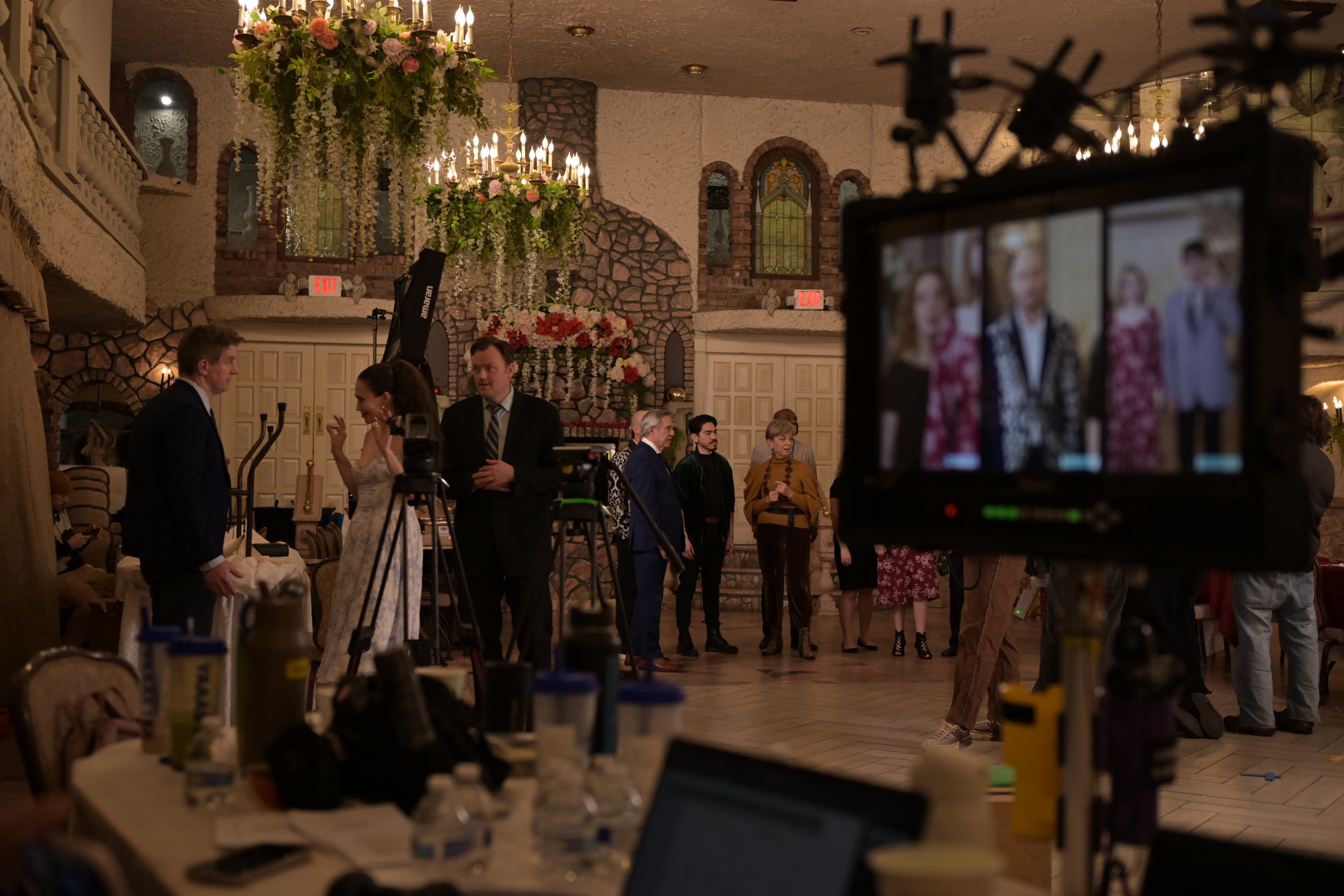
Zhang worked as an executive producer on a live-action banquet scene, a common setting in micro-dramas in Queens, New York, in September 2025. (Courtesy of Bohan Zhang)
Bohan Zhang’s production studio doesn’t hire actors. Instead, the New York-based company uses artificial intelligence to generate characters for vertical videos.
It’s part of a growing wave of micro-dramas, also known as “verticals” or “short dramas.” These video series are typically composed of 50 or more minute-long episodes for mobile users on micro-drama apps such as ReelShort and DramaBox.
The videos feature unexpected twists, intense confrontations, revenge, romantic love with handsome billionaires, and hooks tempting users to pay for subscriptions. The first few episodes may be free to watch, but eventually users have to pay to continue. For ReelShort, the price for weekly VIP is about $20 USD.
When 29-year-old Zhang started his first full-time vertical series producer job in the first quarter of 2024, global micro-drama in-app revenue was $178 million USD, according to market data firm Sensor Tower. Revenue has since soared to $750 million USD in the first quarter of 2026. The U.S. market accounts for about half of global micro-drama revenue excluding China, where the format was created.
AI has brought both new opportunities and uncertainties to this explosively growing industry in the U.S. Zhang’s film production startup is among Chinese-linked companies switching to AI micro-dramas after advances in AI video tools earlier this year made it possible to create lifelike characters. AI productions now account for a majority of ongoing projects, with some completely replacing live-action, according to VOICES’ interviews with several professionals working for major platforms or their contractors targeting the U.S. market. Low cost and short production period is reshaping both filmmaking and employment, creators told VOICES.
Micro-dramas are a rapidly growing market in the United States. American users now spend more time watching micro-dramas on their phones than major streaming platforms like Netflix, Amazon Prime Video and Disney+, according to tech research company Omdia.
The major audience in the United States is 25-to-55-year-old women, several creators told VOICES.
Zhang entered the industry as it was taking off in 2023. When he graduated from Columbia University with a master in creative producing that year, both U.S. and China’s film industries had not recovered from the pandemic, and Hollywood was hit by historic strikes. A Columbia alum referred him to a producer role at the New York office of Reelshort, which is backed by Chinese digital media company COL.
Many micro-drama creators share Zhang’s career trajectory. They are Chinese international students who graduated from prestigious U.S. film schools and now work in the vertical drama world in Los Angeles, New York or Beijing.
“For our generation, we really witnessed the explosive growth of the vertical drama industry from the time we graduated till now. It has quietly changed many people’s fates,” said Hao Sun, who graduated from Johns Hopkins University in 2022 and now the founder of filmmaking company Eclipsee Entertainment.
Micro-drama creators told VOICES that the emerging industry not only provides more chances for young filmmakers, but also offers a more equal workplace for women. The female perspective is also important for the industry because the U.S. audience is mainly women, said Qianfan Chen, a producer working for a leading micro-drama platform’s New York office.
“It gives equal opportunities for men and women,” she added.
Three years since the industry took off, Chinese-linked companies retain their first-mover advantage. In the first quarter of 2026, the top five micro-drama apps by global in-app revenue are all backed by Chinese investors.
Though adapting this format first flourishing in China to U.S. audiences is considered a challenge for these Chinese-linked companies and Chinese staff, several creators believe understanding the unique features of micro-dramas are more important than specific American cultural context.
“When it comes to basic human desires, how to dramatize emotion is actually quite universal,” said Wendi “Paddy” Ma, founder of New York-based vertical film production company Entropy Cat.
Micro-drama streaming platforms are “all-in” AI production now, Ma said. His company, which has produced live-action micro-dramas since 2023, is also switching focus to follow the trend.
“Several live-action projects are still in the pipeline… but they might be shelved or replaced with AI projects,” Ma said.
The sharp drop in cost is the key driver to this change. While the budget of a live-action micro drama is around $200,000, an AI drama could cost less than $50,000, Ma said. And while AI replaces human casts, the crew can also be cut from 25 to 10 people, according to Ma.
AI also wins in speed.
The turnaround time is extremely fast: usually within a month, and often in just two to three weeks, he added. In contrast, live-action dramas usually take two months from project approval to final delivery, which is already significantly faster than movies and TV series, according to Ma.
The core process to generate videos by AI is called “card-drawing”: break down the script, input the prompt to AI, and review the video output. If there is no luck, engineer the prompt and draw again.
The prompt needs to spell everything out in detail including setting, character, facial expression, story, camera movement, and lighting, Sun told VOICES.
“At the beginning, it felt like a bottomless pit. We kept chasing the perfect image. But later we realized that the cost simply could not be controlled in that way,” Sun said. Now, Sun’s team usually generates one clip three to four times, due to budget constraints and long waiting times on AI-generated content platforms.
Generating characters is especially challenging. Qianfan Chen, a producer working for a leading micro-drama platform’s New York office, told VOICES that oftentimes, she generates a character she believes is not similar to any real person, but after reviewing, she finds the character looks like an actor and has to revise again.
To create a character not similar to any specific human but also with its own characteristics, micro-drama creators have to continuously experiment with various strategies. Chen tried to turn the photo of her dog into a person: “AI may pick up on certain traits from the animal, for example, very large eyes, a large nose or a slightly droopy face of a pug, and translate those features into a human character. Characters created this way can be unexpectedly different from the generic, fake-looking AI characters.”
While AI has limitations, AI-generated content also opens more possibilities in terms of plots and themes. AI’s low cost allows producers to experiment with new genres such as fantasy, period dramas and sports, which were constrained by the low budget of live-action, several producers told VOICES.
For Zhang, making AI verticals is a path towards AI production in more formats. While micro-drama production companies are pioneers in monetizing AI productions, he believes there is even more potential for fully AI-generated commercials and movies.
“Not everyone has access to abundant resources, right? But with AI, even though it is not perfect, it can still help you express what you want to express. In that sense, I see AI as an equalizing force.”
Ma is confident about the prospects of this young industry, but where its production will exist is a question. For example, low production costs and a big labor force may shift the industry back toward China.
The move of production has already reflected in the workflow of New York-based producer Christina Wang: “Oftentimes, the contracted companies producing these AI micro-dramas are based in China. So now I have to coordinate with teams back in China across time zones every day.”
While the micro-drama once hired many international students seeking employment in the United States, Wang worried whether the company would keep the U.S.-based producers since she is no longer needed to work on a physical set with a cast and larger crew.
Wang worked as a micro-drama producer before pursuing a master’s degree. She was part of the first cohort of New York University’s virtual production graduate program focusing on this emerging technology combining live actors and virtual sets.
However, by the time she graduated, there were not many available jobs anymore in virtual production. She ended up working in the micro-drama industry again, and now verticals are being shaped by AI.
“When I first joined the company, I had no idea I would end up working on AI (verticals),” said Wang. Her company switched to AI production “all of a sudden”, and she expected herself to work only on AI verticals in the upcoming months.
“The world is changing so fast. You will never know,” she added.
For Wang and other Chinese micro-drama creators, only one thing is certain: AI is accelerating experimentation in this young industry and reshaping entertainment for American audiences and beyond.

University of Michigan
2026 VOICES Fellow
AI
Minneapolis 2026





Apply
Become a fellow or editor
Donate
Support our impact
Partner
Work with us as a brand

The Asian American Journalists Association (AAJA) is a membership nonprofit advancing diversity in newsrooms and ensuring fair and accurate coverage of communities of color. AAJA has more than 1,500 members across the United States and Asia.
