affordability
Student work • Minneapolis 2026
 Japan’s recent influx of tourists and changes in political leadership have created an environment that some say makes it difficult for Japanese Americans to fit in.
Published June 26, 2026
 Emilie Takahashi
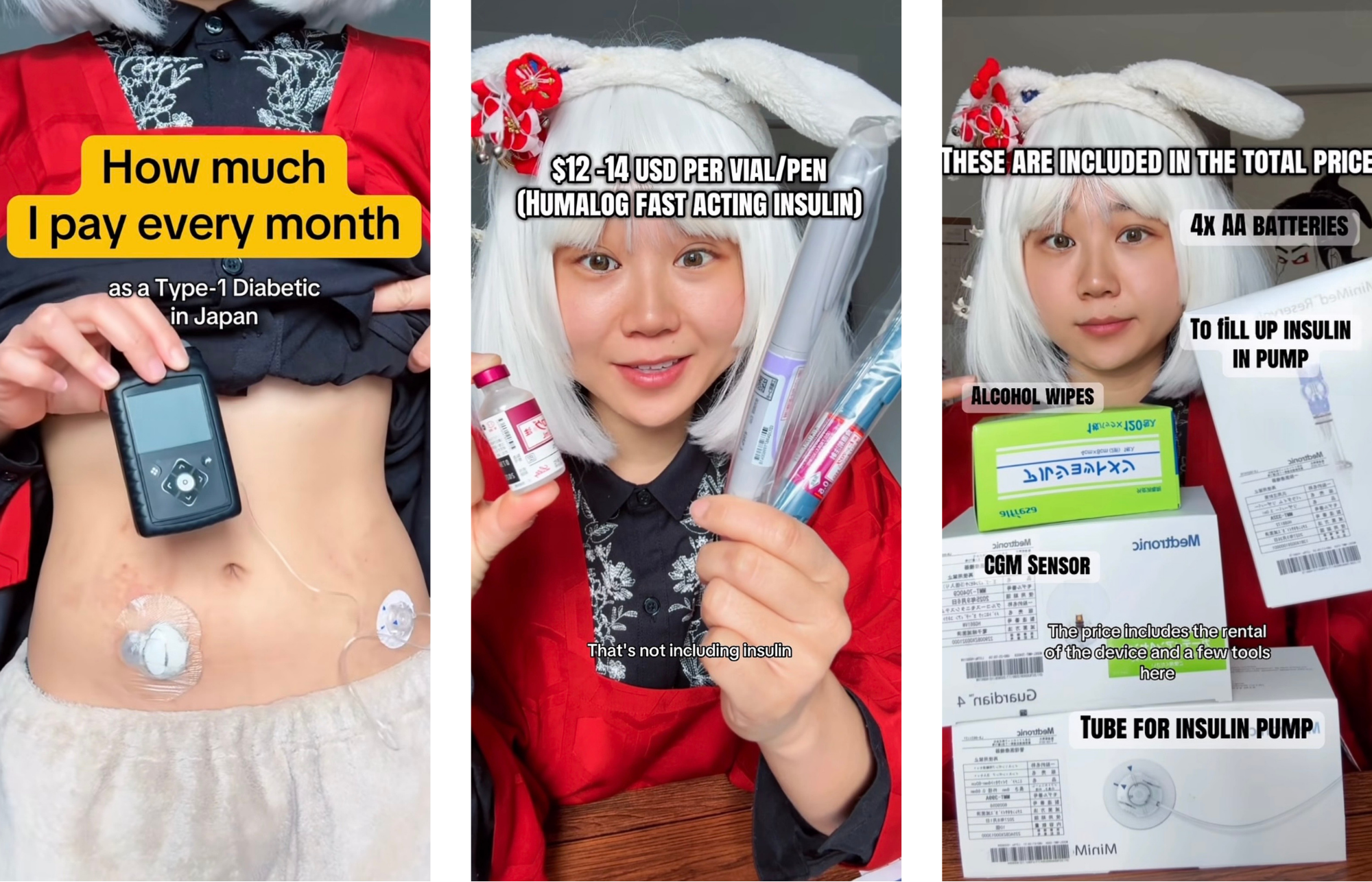
Aimi, known as CyberBunny on Instagram, shares her journey as a Type 1 diabetic living in Japan. She moved to the country to afford her diabetes treatments. (Courtesy of Aimi.)
Aimi, 33, originally moved to Japan out of necessity. In the U.S., she said that she was quoted thousands of dollars out of pocket for her Type 1 diabetes treatments, and that she used to reuse insulin needles to cut costs. Now, however, she said she pays only $190 a month for her medical equipment and insulin.
“Japan saved me,” said Aimi, who spoke to VOICES on the condition that only her first name was used due to safety concerns.
More Japanese Americans like Aimi are immigrating to their cultural home country, contributing to a 45% increase in Americans living in Japan since 2012. While many hope to learn about their heritage, others seek economic relief with the country’s affordable education and universal healthcare.
The cost of living in Japan can be hundreds of dollars lower than in the U.S., according to data from the Statistics Bureau of Japan and the U.S. Bureau of Labor Statistics.
But Japan’s image as a budget-friendly, worry-free paradise is complicated. With a growing foreign population, an increase in tourism and the spread of anti-immigrant political rhetoric and policies, some Japanese Americans are struggling to fit in to their new home, they told VOICES.
“It still feels like I am a privileged visitor,” said Debbie Ruiz, who immigrated to Japan in 2024. “To get to the point where I connect to actual roots and say I am Nihonjin (Japanese), I don’t think I’ll ever get there.”
Fuminori Minamikawa, a professor at Doshisha University’s Graduate School of Global Studies, said he has noticed a new wave of Japanese American students in his English-taught classes in the past few years.
Minamikawa, who studies the Japanese immigrant community in America, said he’s heard about people moving to Japan for economic reasons, looking for jobs and lower living costs.
The average American household in 2024 spent roughly $850 and $520 a month on food and medical care, respectively, according to the U.S. Bureau of Labor Statistics.
That same year, the average Japanese household spent a fraction of that amount per month, at around $430 on food and $80 on healthcare, according to the Statistics Bureau of Japan.
For Aimi, accessing diabetes treatments in the United States was getting too expensive, and she said she was looking for an escape from a “broken” healthcare system.
Her family supported her, saying that a life in Japan was a better fit for a diabetic, with high-quality food, a walkable lifestyle and access to affordable healthcare.
“(My parents) came to America looking for better benefits, and in that generation, they were right: They had better opportunities back then,” Aimi said. “But in our generation, it’s reversed.”
Mattea Cibach, a second-year student at Ritsumeikan University in Kyoto, chose a Japanese university for an affordable education without student loans.
Cibach said she grew up fearing being saddled with student debt and chose Japan for a degree she could pay for out of pocket.

Today, tuition at a national Japanese university costs around $5,100 a year, according to the Ministry of Education, Culture, Sports, Science and Technology of Japan. College tuition at a public university in America would have cost Cibach between $9,000 to $20,000 a year, depending on where she attended, according to 2024 data from the U.S. Department of Education.
“When the prices for tuition are one-fourth of the tuition for American colleges, it becomes an easier decision to move away,” Cibach said over text.
When Ruiz moved to Osaka after retiring in 2024, she said she found apartment prices to be almost 70% lower and her monthly expenses significantly cheaper than when she was living in Hawai‘i. When Ruiz had to take multiple CT scans at urgent care after a bike accident, she said she only paid $40 out of pocket.
“Japan is so much cheaper than Hawai‘i at this point, probably cheaper than anywhere on the mainland,” Ruiz said.
While affordability is encouraging many Japanese Americans to immigrate to Japan, the country is seeing a rise in tourism that Minamikawa said impacts their ability to fit in.
In recent years, Minamikawa said he has seen a rise in anti-foreigner sentiment among the Japanese public. He said he’s also seen politicians and social media fueling that fire.
Overtourism is one of the factors contributing to a rise in negative sentiments against foreigners and immigrants, Minamikawa said. Japan saw almost 43 million tourists in 2025, more than double the number of tourists a decade before, according to the Japan National Tourism Organization, a government agency.

Although her friends and neighbors are kind to her, Ruiz recounted seeing anti-foreigner commentary on social media as well as a rise in political leaders preaching anti-immigrant policies. She said she felt that, as someone on a visa, she would never be Japanese.
Additionally, she said new visa rules and potential language requirements from the country’s prime minister, Sanae Takaichi, may make it more difficult for her to stay in Japan.
“It’s a collective sense of being not so much welcomed,” Ruiz said.
In a mostly homogeneous country, it can be difficult for Japanese Americans to feel like they belong, Minamikawa said. Foreigners only make up around 3% of the population in Japan, according to the country’s Immigration Services Agency in Japan.
“Even if (Japanese Americans) felt a sense of being Japanese in America, they become a foreigner in Japan,” he said in Japanese.
Feeling pressure to fit in when she first moved, Aimi remembers trying to “act Japanese,” getting bangs, dressing more feminine and acting more “amenable”. Now seven years later, she runs a tour business and social media channel, Cyber Bunny, sharing a “survival guide to Japan” for Americans.
“In the very beginning, I tried to be 100% Japanese,” Aimi said. “But by year two, year three, I could not hold back. I am Japanese American.”
For some, the challenge of belonging may outweigh the benefits of living in Japan. Cibach said she felt more at home with her mixed identity in Hawai‘i and is thinking of returning to the United States after college.
Others, however, are slowly feeling more in tune with their new environment.
Although Ruiz said she still feels like a visitor, she’s slowly reclaiming and learning more about her Japanese identity. For example, she began studying Japanese, visiting local temples and reuniting with her Japanese family.
“When I’ve been brave enough to go into places that scared me away before, it’s been positive,” Ruiz said. “I think the longer I stay here, the more comfortable I will be.”
Minamikawa said the growing anti-immigrant sentiment doesn’t take into account the fact that Japan is a part of the “global migration history,” sending immigrants to the United States, Brazil and elsewhere across the world throughout the last century.
Understanding what it means to be Nikkei, which means “of Japanese heritage,” today can help reshape and improve the narrative around immigration in Japan, Minamikawa said.
“In modern history, Japan is a part of such international migration,” he said. “Japan is not an isolated country.”
This story was included in The Xylom’s newsletter, The Roots and The Shoots and republished in AsAmNews.
UC Irvine
2026 VOICES Fellow
Minneapolis 2026





Apply
Become a fellow or editor
Donate
Support our impact
Partner
Work with us as a brand

The Asian American Journalists Association (AAJA) is a membership nonprofit advancing diversity in newsrooms and ensuring fair and accurate coverage of communities of color. AAJA has more than 1,500 members across the United States and Asia.
