AI
Student work • Minneapolis 2026
 AI chatbots offer convenient, judgement-free help navigating American medicine, tax forms, therapy and social customs, students said.
Published June 26, 2026
 Delphine Liu
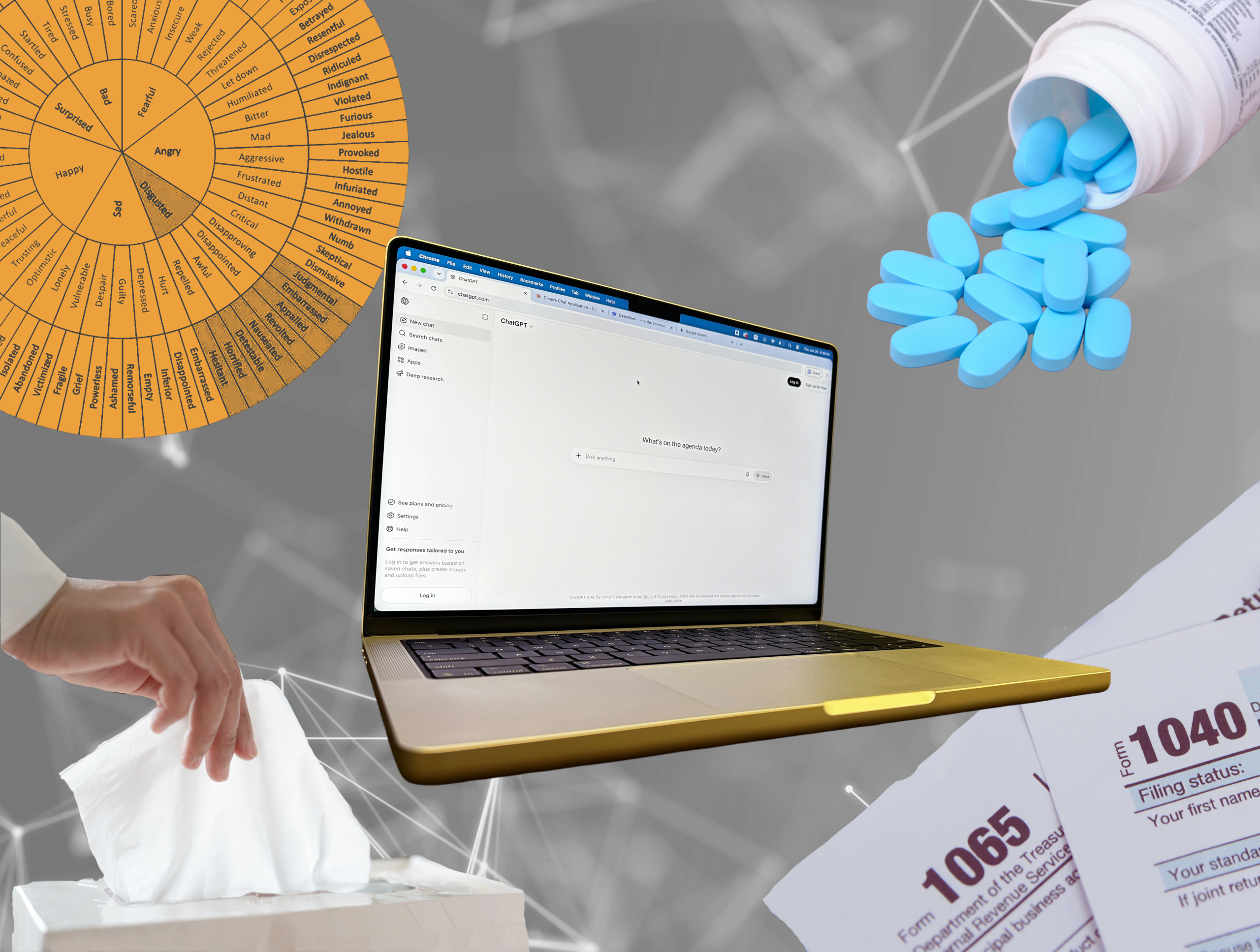
International students living in the U.S. told VOICES they are turning to artificial intelligence tools for help navigating American medicine, tax forms, therapy and social customs. They said AI chatbots offer convenient, no-judgement options for help as they navigate life overseas. (Graphic by Delphine Liu)
At the instruction of ChatGPT, Vivienne Hnin, a Burmese international student, had been double-dosing on Nyquil for five days.
It left her drowsy, dehydrated and extremely disoriented.
“(My classmates) thought I had alcohol poisoning,” said Hnin, a student at University of North Carolina at Chapel Hill. “I didn’t know if I should tell them the truth … because alcohol poisoning kind of sounds better than overdosing on the soft gel and liquid version of the same medication because you asked ChatGPT.”
Hnin and other international students living in the U.S. told VOICES they are turning to artificial intelligence tools for help navigating American medicine, tax forms, therapy and social customs. They said AI chatbots offer convenient, no-judgement options for help as they navigate life overseas.
The students said adjusting to life in the U.S. can be difficult because of language barriers and knowledge gaps. Those challenges are sometimes exacerbated by a lack of support at their universities, one student shared.
“When you are panicking in a foreign country, (AI) provides stability,” said Lucyia Huang, a student from China who attends UNC.
However, there are a growing number of mixed reviews of AI’s effectiveness among the students using it to navigate life in the U.S. Students are learning more about AI’s inaccuracies and drawbacks and, now, deciding to use these tools in tandem with in-person resources and human oversight.
When Huang moved to the U.S. for school, she said found herself in a place she did not understand. The food was different and so was the culture — and she was left to navigate a foreign country alone, with her family thousands of miles away.
“It’s a fast transition and AI can help you,” Huang said.
Although many colleges and universities throughout the country have offices meant to help international students adapt to their new surroundings, the level of support varies.
Huang mentioned how the International Student and Scholar Services office, or ISSS, at UNC is not open 24/7 for help.
In addition to a lack of university resources, Huang said that she seeks the help of AI because she doesn’t want to worry her parents back home.
“I don’t really like using AI to help with these tasks,” Huang said. “I just currently can’t find someone or something more responsive and patient.”
Ava Hu, a Chinese student who recently graduated from the University of California, Berkeley, said she used her school’s international services office in tandem with ChatGPT.
Ava said she utilizes ChatGPT everyday, including for emotional support. She added that the tool is available “all the time” and that anyone can ask an unlimited amount of questions for help.
“It’s just more customizable,” Ava said.
She said that because there is stigma surrounding mental health discussions in her home country, a lot of her international student friends were curious to try therapy when they arrived in the United States. Many are turning to ChatGPT because of its accessibility, Ava said.
Ava added that growing up, she had never heard of therapy.
“The whole system (in China) is not built for it,” Ava said. “Therapy is not accessible, or if you go to a doctor, it will (not) really be considered as an illness.”
Alex Hu, a student from China at UNC, said he has used conversational AI for emotional support because it allows him to express himself without judgement.
However, Alex added that he is aware of the tool’s shortcomings. He said that although talking to AI chatbots can help him “settle his mind,” they often reinforce his existing beliefs.
After several months of using Claude for therapeutic services, Alex started seeking additional support from a licensed therapist. But, after suspending his therapy sessions, he continued to use the chatbot as supplemental care.
International students in the U.S. have to fill out immigration forms based on their status and type of employment in order to work in the country legally. Many of the students VOICES spoke to said they not only used AI chatbots to help with tax forms but also important visa, health insurance and social security paperwork. That includes students like Satvik Chethan, who is from India and recently graduated from UNC.
Like Huang, Chethan said he also found AI more convenient than the school’s international student center.
“Every little silly question that I can’t set up a one-on-one with ISSS for, I can ask AI,” Chethan said.
Zylia Zhang, an international student from China at UNC, said she asked Claude to help her fill out tax forms for her summer internship in the U.S. She relied on the chatbot because neither her employer nor the university offered tax help, she said.
“There were so many forms I had never heard of,” Zhang said.
Andrea Lui, a student from Canada who graduated from New York University this spring, said she has been using AI tools to help clarify legal definitions found in her application to temporarily work in the U.S. through OPT, or Optional Practical Training.
OPT allows international students on F-1 visas to legally work in the U.S. at jobs related to their degrees.
Huang said she also used AI when applying for a visa to travel to Estonia for a study abroad program.
“Even though I think that my English is good enough … when it comes to bureaucratic stuff, it is very helpful in understanding the big words that are trying to trick you,” Huang said.
Although Huang said she does not trust AI tools for translation entirely, she does use it to check her work.
“As a second language speaker I worry about if I use improper grammar I won’t be understood,” Huang said. “If I use it, I use it as a reference or a check. I use AI as a final round to determine if something is actually wrong.”
The approach of using AI with human oversight is one that Chethan, who currently works for a data protection company, said is particularly necessary when using the tool for medical advice. It can create “heartbreaking” situations without a human check, he added.
“It’s a technology that can do so much but the outputs and possibilities are scary,” Chethan said. “Especially when you do not have enough education on how to use them.”
After Hnin’s overdose, she became much more aware of chatbots’ pitfalls. She said she learned not to trust the technology blindly or use it as a primary resource.
Despite her critiques and negative experience, Hnin has not shied away from using AI for medical purposes. As a computer science major, she’s hoping to use AI for projects relating to early dementia detection in her future career.
“I believe these technologies have the potential to improve healthcare, but only when they are rigorously validated, transparent about their limitations and used alongside human expertise,” Hnin said.
CORRECTION (6/27): A previous version of this article incorrectly stated that Vivienne Hnin was a business major. She is a computer science major at UNC. The article also incorrectly described Hnin’s work.
University of North Carolina - Chapel Hill
2026 VOICES Fellow
AI
Minneapolis 2026





Apply
Become a fellow or editor
Donate
Support our impact
Partner
Work with us as a brand
The Asian American Journalists Association (AAJA) is a membership nonprofit advancing diversity in newsrooms and ensuring fair and accurate coverage of communities of color. AAJA has more than 1,500 members across the United States and Asia.
